
If you’ve studied piano for a little while, chances are you’ve come across the word minuet—often in beginner method books, Bach collections, or early Classical pieces. But what exactly is a minuet, and why does it appear so frequently in piano education and classical music repertoire?
In this article, we’ll explore what a minuet is, where it comes from, how it works as a musical form, and why it plays such an important role in a pianist’s musical development.
Quick Definition
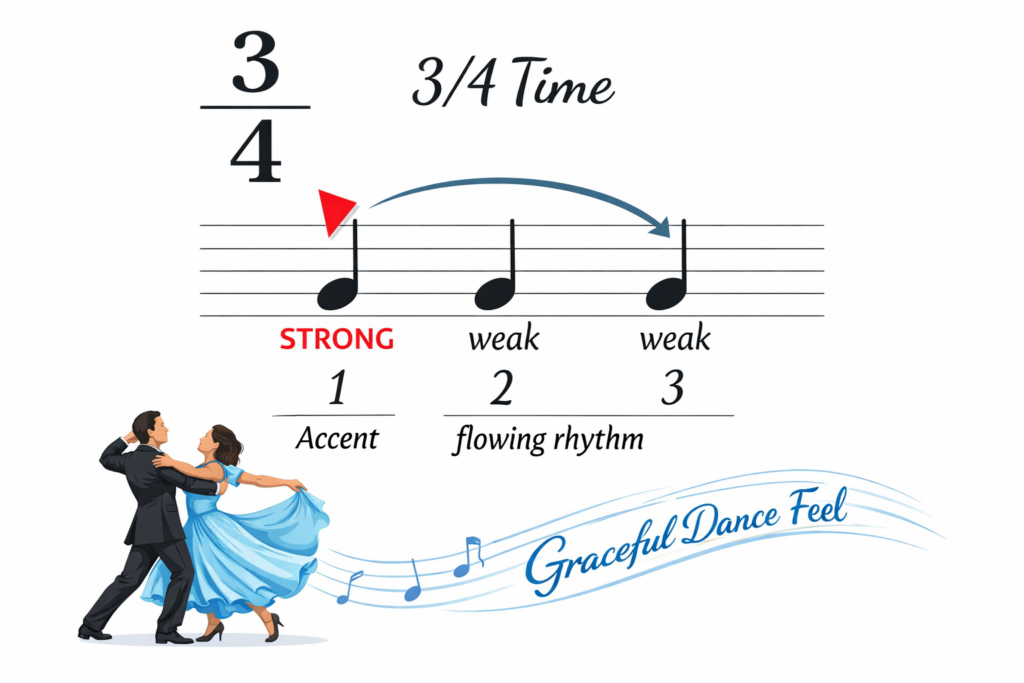
A minuet is a musical form that originated as a French court dance, typically written in triple meter (3/4 time) and performed at a moderate tempo. In classical music, a minuet is usually a short, elegant piece built from balanced phrases and clear harmonic structure.
In instrumental music, especially from the Baroque and Classical periods, the minuet evolved from a social dance into a stylized musical form, often appearing as an independent keyboard piece or as a movement within larger works such as suites, symphonies, and sonatas.
Where Did the Minuet Come From?
The minuet originated in France during the 17th century as a court dance performed by the aristocracy. The name comes from the French word menu, meaning small or delicate, reflecting the refined steps and graceful movements of the dance.
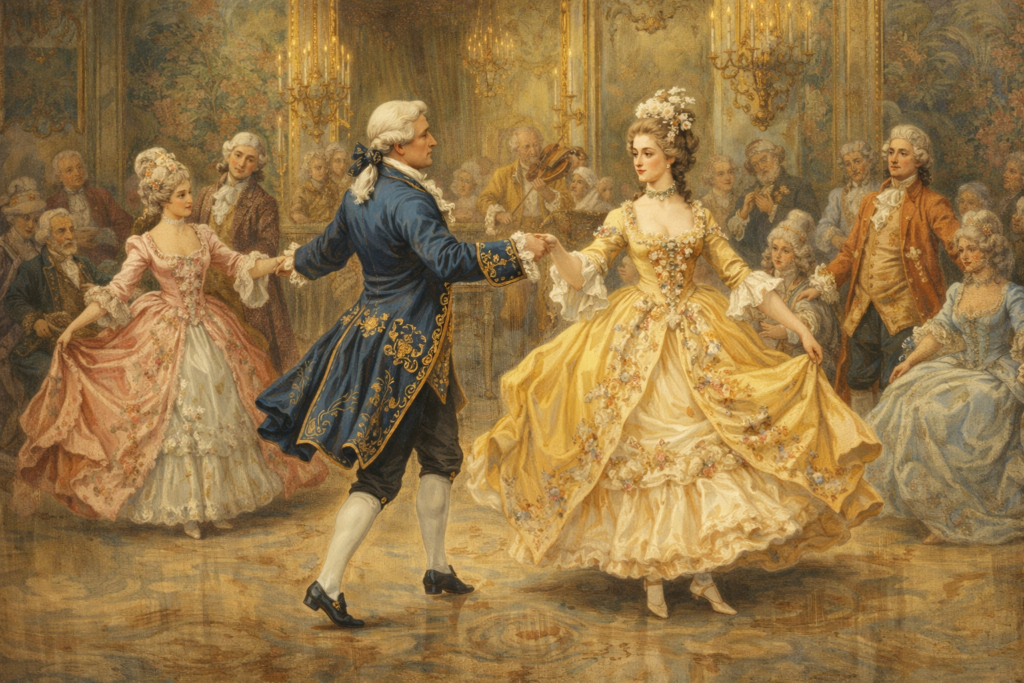
As the minuet gained popularity, composers began adapting it for instrumental music. By the late Baroque period, it had become a common movement in dance suites, alongside forms like the allemande, courante, and sarabande.
During the Classical era, the minuet reached its peak importance. Composers adopted it not just as a dance, but as a formal musical structure suitable for symphonies, chamber music, and keyboard works.
The Minuet as a Musical Form
Musically, a minuet is built around symmetry and balance. Most minuets are written in 3/4 time and organized into phrases that feel predictable and elegant.
A typical minuet consists of two sections, each repeated:
- The first section establishes the home key and presents the main musical idea.
- The second section often explores a related key before returning to the home key.
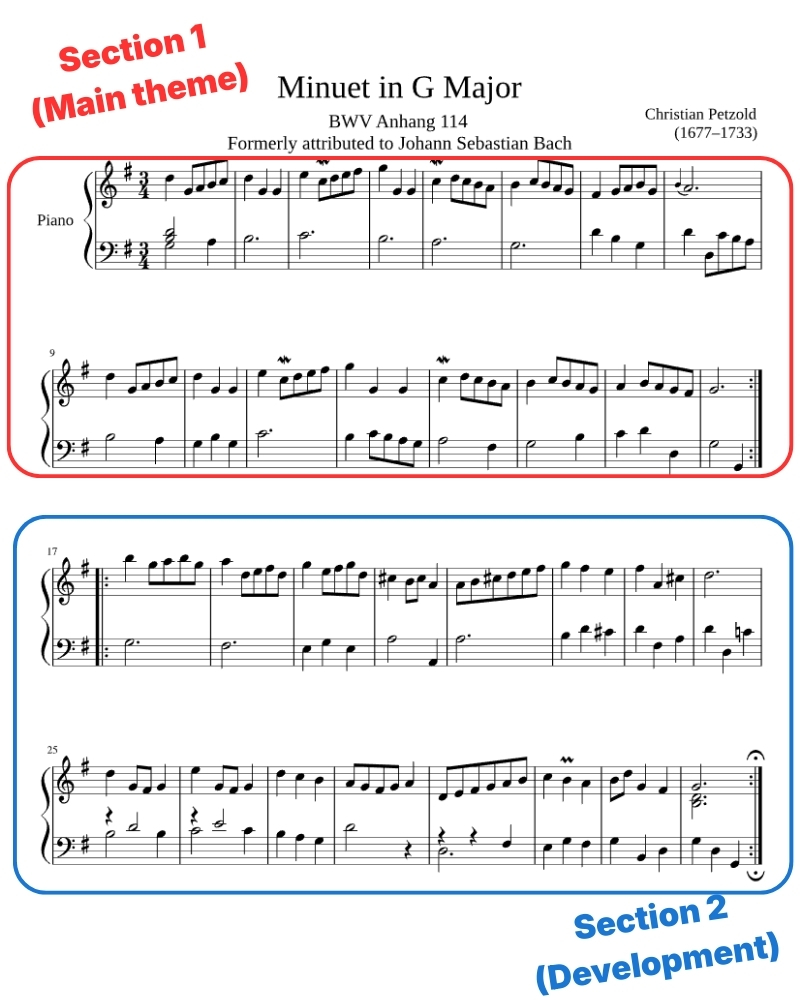
Each section is commonly eight measures long, creating a clear and structured feel that makes minuets especially useful for teaching musical form and phrasing.
Minuet and Trio: How the Structure Works
One of the most recognizable features of the minuet is its pairing with a trio. This creates the classic Minuet – Trio – Minuet structure.
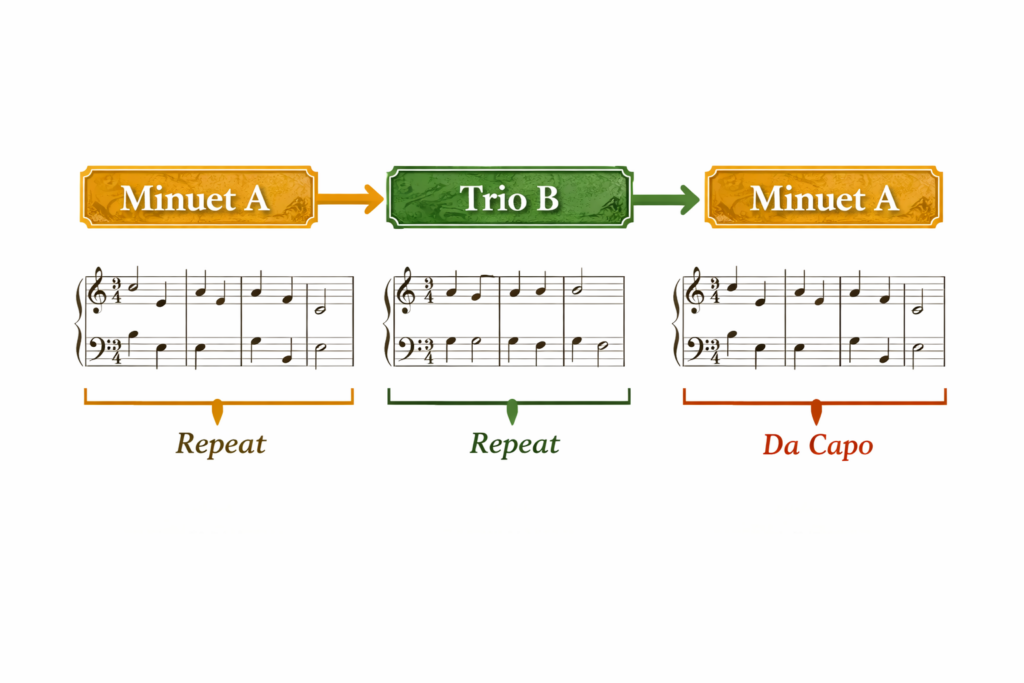
The first minuet presents the main material. The trio then follows, offering contrast—often through a lighter texture, different key, or smoother melodic style. After the trio, the original minuet returns, usually without repeats.
Despite the name, the trio does not necessarily involve three instruments. Historically, it referred to a lighter middle section, often scored for fewer voices.
Minuet vs. Waltz vs. Scherzo
Because they share triple meter, minuets are sometimes confused with waltzes and scherzos. However, these forms differ significantly in character and purpose.
The minuet is moderate in tempo and refined in style, reflecting its origins as a court dance. Waltzes are typically faster and more flowing, associated with Romantic-era ballroom dancing. Scherzos, which replaced the minuet in many Classical-era symphonies, are faster, more energetic, and often playful or dramatic.
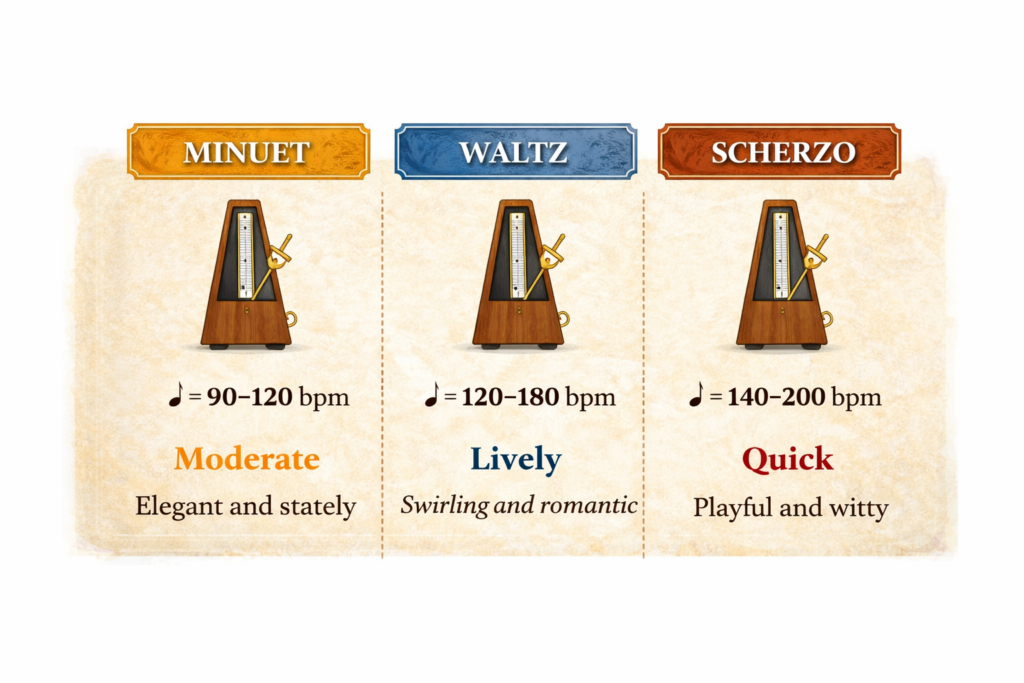
Understanding these differences helps pianists interpret each form with the appropriate articulation and expression.
Famous Minuets Every Pianist Encounters
Many pianists first encounter minuets through educational repertoire. Keyboard collections from the Baroque and Classical periods frequently include short minuets designed to develop coordination, rhythm, and musical elegance.
Minuets also appear as movements within larger works, such as symphonies and sonatas, where they serve as lighter, dance-like contrasts to more dramatic movements. Although these pieces often look simple on the page, they demand control, balance, and stylistic awareness.
Baroque Minuets Every Student Knows
Several of the most famous minuets studied by pianists come from Baroque-era keyboard collections, especially those associated with Johann Sebastian Bach and his circle.
One of the most widely studied keyboard pieces of all time is the Minuet in G Major, BWV Anh. 114. Traditionally attributed to Bach but now credited to Christian Petzold, this minuet appears in countless beginner piano books and is often a student’s first exposure to music in 3/4 time.
Closely paired with it is the Minuet in G Minor, BWV Anh. 115, which introduces a more expressive, introspective character while reinforcing the same formal clarity. Many teachers assign these two minuets together to highlight contrast within a shared structure.
Another frequently studied example is the Minuet in D Minor, BWV Anh. 132, valued for its articulation challenges and clear phrasing, despite its modest technical demands.
These works are commonly found in the Notebook for Anna Magdalena Bach, making them a cornerstone of early Baroque keyboard study.
A further popular Baroque example is the Minuet in A Minor by Johann Krieger. Although less universally known than the Petzold minuets, it appears frequently in teaching anthologies and exam syllabi, particularly for its expressive minor-key character and clear dance phrasing. Many students encounter this piece as an early introduction to expressive shading within the minuet form.
Classical-Era Minuets in Piano Repertoire
During the Classical period, minuets became standard movements within larger forms. Pianists regularly encounter minuets embedded in sonatas and other multi-movement works by composers such as Wolfgang Amadeus Mozart and Joseph Haydn.
Well-known examples include the Minuet from Mozart’s Piano Sonata in C major, K. 545, as well as minuet movements found throughout Haydn’s piano sonatas and symphonies. In these works, the minuet functions as a graceful contrast to more dramatic or virtuosic movements.
Although Classical-era minuets are less frequently studied in isolation than Baroque keyboard minuets, they play a crucial role in teaching Classical style, elegant articulation, and proportional phrasing. In many teaching contexts, selected minuet movements are used to introduce students to Classical-era aesthetics and formal balance.
Minuets Written for Teaching and Study
Several composers intentionally wrote minuets and dance-like keyboard pieces with pedagogical goals in mind. Muzio Clementi, best known for his sonatinas, also composed short movements in dance style that closely resemble minuets and serve similar educational purposes.
Other composers, such as Leopold Mozart, produced keyboard minuets designed specifically for young players, emphasizing clarity, balance, and stylistic correctness.
Finally, the work of Christian Petzold deserves special mention. Beyond the famous minuets long attributed to Bach, Petzold wrote several keyboard pieces that continue to appear in student repertoire due to their simplicity and strong formal design.
Together, these minuets form a shared musical vocabulary for pianists. Studying them builds a foundation in rhythm, phrasing, and Classical style that prepares students for larger forms such as sonatinas, sonatas, and scherzos.
Are Minuets Always Easy?
While many minuets are written for students, they are not necessarily easy. Technically, they may avoid virtuosic passages, but musically they require precision.
Clean articulation, steady tempo, proper emphasis on the first beat of each measure, and elegant phrasing are all essential. A poorly shaped minuet can quickly sound mechanical or heavy, losing its dance character.
This makes minuets an excellent bridge between beginner pieces and more advanced Classical repertoire.
How Pianists Should Approach a Minuet
When learning a minuet, pianists should focus first on rhythm and balance. Feeling the natural pulse of 3/4 time is crucial, with a gentle emphasis on the first beat.
Articulation should remain light, and phrasing should follow the natural rise and fall of the musical lines. Dynamics are usually subtle, reinforcing symmetry rather than dramatic contrast.
Practicing with an awareness of the dance origin can greatly improve musical expression.
Why Minuets Are Important in Piano Education
Minuets play a key role in piano education because they introduce students to classical form in a compact and approachable way. They help develop rhythmic stability, stylistic awareness, and an understanding of musical symmetry.
They also prepare pianists for larger forms, such as sonata movements and scherzos, by establishing a foundation in balanced phrasing and structural clarity.
Common Questions About Minuets
- Is a minuet always in 3/4 time?
- Most minuets are written in 3/4, but composers occasionally experiment with similar triple meters while maintaining the characteristic feel.
- Is every piece called a minuet meant for dancing?
- No. Many minuets are stylized concert pieces inspired by dance, not intended for actual dancing.
- Why did composers stop using minuets?
- Over time, the scherzo replaced the minuet in many Classical and Romantic works, offering greater speed, contrast, and expressive range.
What to Learn After Minuets
After studying minuets, pianists are well prepared to explore scherzos, early sonata movements, and longer Classical forms. The skills developed through minuets transfer directly to more complex repertoire.
Bottom Line: What Is a Minuet?
A minuet is a graceful musical form rooted in dance, typically written in triple meter and built on symmetry and clarity. Though often short and technically accessible, minuets demand musical refinement and stylistic understanding.
For pianists, learning minuets is an essential step toward mastering Classical music and developing a strong sense of musical structure.



Leave a Reply